Saturday, February 9, 2013

152> Standardizing for the Future


When I first started this blog, I did so with the conviction that what PRT needed was some sort of standardization – a way to allow PRT to be a joint venture between specialized companies doing what they do best, instead of some little startup trying to be ten companies at once.  That way a depth of resources could be brought to play that could never be matched by any other method, except, perhaps, direct government subsidies. 

Times have changed and things are changing faster by the minute.  This was spelled out to me, yet again, as I was writing my last post on forward-compatibility and extensibility.  In that post I outlined a “last mile” strategy, and it involved slower, bare-bones loops within loops – almost like big long circular driveways.  This represents an important call… A call for a plurality of speeds. (I have called for high speed routes as well.)  This requires a degree of control complexity that seemed pretty far-fetched just a couple of years ago. 

A related topic involves vehicle size. Many see the utility of using the track for other purposes beside strictly passenger service. Freight could be delivered, for example, straight into buildings and even into offices or down store isles with vehicles specifically designed for the task. Many will also agree that there might be some cases when passenger vehicles of differing sizes would be appropriate. That means that these two qualities (multi-speed and multi-sized) would require a track that would support such configurations. A system designed to be forward-compatible and extensible into the relatively distant future should, therefore, ideally incorporate such possibilities in a current track design, even if such features are not part of the current system iteration.

One problem with getting the most out of the infrastructure that this track represents is the question of ownership and maintenance.  Back in the day, PRT was thought of as one big machine, presumably operated by a specialized team stationed at the terminals of some giant mainframe.  Now, with distributed computing, cloud based sharing, dirt cheap sensors and the rest, there is real question as to how much will really need to be done centrally.  After all, if you give Google’s automated cars their own lane and program them to pick you up, taxi-style, haven’t you just created a PRT system that is essentially like ULTra?  The key point, it seems to me, is vehicle autonomy.  If positionally-aware, constantly communicating vehicles can take current traffic data and pick (and report) their own routes, and they can be made to establish safe headways and merge safely, then managing the system would potentially be much simpler than what is currently done by law enforcement for our roadways.  Taking the intelligence out of the track, it appears, has benefits.  Is “dumb” track the most forward-compatible and extensible choice?  Quite likely, I think.  It is also cheaper and therefore more extendible in terms of coverage, and is less “breakable” as a system.  Thank goodness for technological advances!

 It may even be the case that it is easier to get through regulation hurdles with autonomous vehicles on dumb track.  After all, it’s hard to argue that a tracked environment is somehow more dangerous than the unpredictability and traction-dependence of city streets, where driverless automobiles would go.  Also the specter (or assumption) of larger, multi-passenger vehicles seem absent from the safety discussions at present.  I don’t believe Google’s robocars have had to pass any APM (Automated People Mover) standards and they certainly haven’t been subject to the arcane rules designed for trains, something that has been of arguable concern in PRT circles.

Let’s bring standards back into the discussion.  As I said in the opening, I have long been an advocate of open-source standards for PRT, so that a system can be made by a multiplicity of specialized companies. But I am also very wary of setting standards too soon, as they could rope the whole effort into one that favors an inferior design or soon-to-be obsolete technology.  One important reason to establish them, though, has to do with the PRT business model.

From a point of view of doing the most for society and the wellbeing of the planet, the best model would be for the track to be open to all qualified vehicles…any and all meeting certain standards.  There is every reason to want to take as many vehicles off of the roads as possible, and so there is good reason to make the track as versatile as possible in that regard.  This brings us right back to extensibility and forward compatibility.  Note that I said “model” and not “business model.”  From the “PRT business” point of view, designing for the distant future makes no sense.  Any PRT startup has no choice but to begin in the least complicated way possible.  In terms of overall long-term business growth, though, it makes great sense.  What is good for society and the planet also unleashes all sorts of potential business models that cannot exist today.  Maybe tiny delivery “bots” will bring you your pizza.  Wouldn’t that beat the current paradigm of using a person, fossil fuel, and a multi-ton vehicle to do the job?   The point is that extensibility and forward-compatibility are only useful to a business insofar as they relate to their best financial interest in the relatively near future, and therefore their designs will reflect this, even if those designs do not reflect the best interest of the environment, traffic mitigation, or other such benefits. 

I envision a business model where a PRT company serves as a general contractor and business partner with a city, but whose role gradually diminishes with time.  In such a scenario the revenue stream and responsibilities gradually shift to the city, although obviously the PRT company could always be kept on for whatever role is agreed upon.  The important point here is that the PRT company’s exclusive rights to the track should have an endpoint.  This would seem attractive to the city, since it does not have to grant never-ending monopoly status to a company that may or may not live up to expectations.

This is where design extensibility and forward-compatibility meet open standards, business viability, as well as societal and ecological priorities.  Although it makes no sense for a PRT provider to design a track that can, someday, more efficiently deliver pizza, mail or bags of cement, it makes more sense to the eventual owner, the city.  The city’s needs are much more closely attuned those environmental, societal and macro-economic problems that PRT has such great potential to solve.

This mismatch between a PRT provider’s needs and a city’s needs directly influence the desirability of PRT as a meaningful alternative to other transportation solutions.  If PRT is to represent a prudent investment in the future, there should never be a possibility of having to scrap miles of track because of aging vehicles or an obsolete operating system, or a bankrupt PRT company.  Every component should be able to be updated – forever.  Perhaps this is why, although rail-type PRT offers numerous advantages over pavement based systems, it is the latter that is making the most inroads.  An elevated mini-roadway may not be what I would prefer to have going down my street but it is clearly an extensible choice.  It could be used for bicycles, scooters, golf carts, pedestrians, manned electric taxis, whatever.  This represents a safer investment for city planners, even as it caps routing choices and speeds.

A standardized PRT platform that is easily adapted and upgraded would similarly represent a safer choice, if the various parts of the system were sufficiently simple.  The owners (the city) should preferably have a system where they could simply take bids for repair, replacement, expansion, etc.  The main danger is that such a standard will be a bad one.

It seems to me that building a good standard should be a lot like building a sound structure…  Start with a sure foundation.  This can start with a wish-list.  The two listed above - to allow multiple speeds and multiple vehicle types, are neither required nor advantageous in early iterations, and so without the altruistic guidance of forward-looking standards such qualities could take many decades to see the light of day.  The same could be said of multi-axis capabilities, guideways that can carry street lighting and utilities, and other qualities that might be on our list.  But if we really want PRT to make a dent in the miserably obsolete transportation status quo, we need to look far ahead and plot a course.

Standards can be very exact and legally precise or vague but definitional - a “standard” putter, for instance.  The latter, consensus-driven definition always precedes anything more exact, and there is not a great deal of consensus on PRT design.  But what can we generally agree on in terms of PRT’s eventual role?  About the objectives that are important to the environment, the society, the economy, etc.?  What qualities will create the potential for a pervasive system?  What qualities will eventually permit the most efficient management of the system?

Extensibility and forward-compatibility are vitally important, even in the areas of ownership, management, societal benefit, etc.  These factors can influence choices that foster the widespread proliferation of PRT or keep it as a fringe technology that only benefits a few.  I advocate going beyond the narrow scope of practical first steps, and into a broader discussion of all of the qualities that are needed for ideal future terrestrial transportation so that we may better steer in that direction.  The priorities of such a hypothetical system are surely different than those of systems that are being promoted as already set for deployment.  Still it is an exercise that we need to do, especially since what is being offered is finding such tepid acceptance. 

Wednesday, January 16, 2013

151> Forward Compatibility and Extensibility


A great PRT design should squarely address forward compatibility and extensibility. These are two distinct, although related, concepts.  To be forward compatible a current system must be designed to gracefully interact with future versions of itself. This is extremely important with PRT because the track or guideway will generally become a permanent piece of infrastructure whose design should support any conceivable future vehicle improvements.

Extensibility is somewhat different. It is the ability of a system to be adapted to whole new uses. An example for PRT would be to use the system to deliver freight. Designing to be extensible is a whole different challenge because it tends to conflict with the optimization of a system for the original purpose. Nevertheless it certainly seems silly to foreclose future functionality through design decisions that might otherwise be completely arbitrary.

Some current PRT offerings seem to have been forced, presumably by financial restraints, to curtail design features that would enhance forward compatibility and extensibility. It remains to be seen whether this strategy helps PRT adoption or actually hurts it by limiting the flexibility needed to address a city’s varying needs.

One example of this, which we will examine here, is the off-line station paradigm, which has become an assumed characteristic of PRT. This notion presupposes a number of issues, most notably a steady flow of would-be riders at every station site. One of the strengths of PRT is that it does not rely on aggregating passengers to fill large vehicles. This advantage is traded away, however, when the cumulative cost of feeder track and an elevated station effectively means that it must be busy at all times to pay for itself. This requires a pedestrian density that typically won’t be found throughout the city. Yet PRT is envisioned as a distributed network – one that only realizes its full promise with large geographical reach and many stations. If you have already grouped people together, and you are sending them all to one of only a few destinations, what is the point of doing it in individualized vehicles? Sure, the individualized vehicles make the system extensible…just add track. But does the city’s layout include contiguous station sites with sufficient pedestrian density to make each station viable?

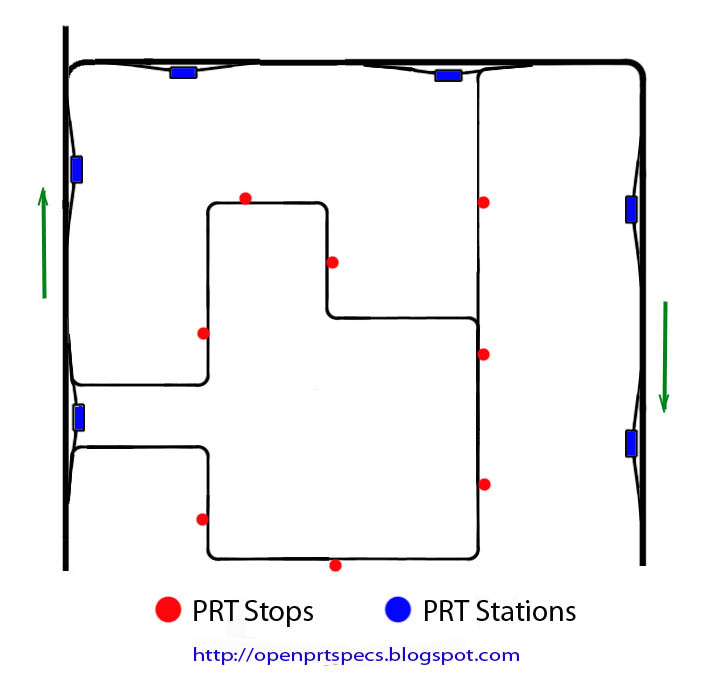
One idea that I have never seen discussed is to have low speed loops that serve minor stations, each having only a very short drive-in-back-out spur. In such an arrangement these loops would act as feeders for a more conventional route with greater speeds and capacity, similar to the feeder roads along freeways but looping away to get greater geographical reach. The regular line would have the more conventional off-line stations. In this design, which works like a typical residential road where residents back out of their driveways, vehicles would obviously need to wait their turn, just like the road-based counterpart. Still, significant local traffic can pass without this being a significant disruption. The idea would be to keep each loop small enough to limit traffic to just a few vehicles per minute. This would presumably be able to service several city blocks in areas where there are no high-rise buildings to create high peak demand. With a control system that allows variable vehicle speed, vehicles on such a slow loop can exit at very low speeds, meaning the spur would be a sharp turnoff, and not a long  deceleration ramp.

The picture at the top of the page shows how, in a fully 3D system, a spur can be dropped anywhere.  Bus stops are particularly attractive destination choices, since they come readymade with seating and at least some sort of cover. The picture below shows a portion of a traditional PRT loop with low speed track serving the areas within. In this example there is one way in and two ways out, but there are probably hundreds of other possible configurations. In this example the same deceleration/acceleration ramps are used for off-line stations and to access the slow loop.


It should be noted that the low speed track can be manufactured more cheaply than higher speed track because it can be designed for greater headway, (less weight) sharper turns, (kept within an easement) can be designed to never admit heavier vehicles, and would not have as much stress from vehicle inertia. It would also require less copper because of the scant traffic load.

To bring this all back to the subjects of extensibility and forward compatibility, this is an example of designing PRT with both in mind, especially in the direction of less expense and greater coverage. Larger, heavier or faster systems will necessarily cost more, and this is what cities are most likely to seek when there is an immediate, otherwise intractable problem. PRT configurations need to address these immediate concerns first. But for a long-term, more comprehensive mobility solution, a more extensive network is needed. Thus there is a need for extensibility toward the lighter, cheaper track and stations that could put more areas in reach. On the other side of the coin, in a growing city, faster, longer range (and maybe even bigger) solutions will be increasingly needed, so a system should be able to grow into those roles as well.

Clearly, it is less challenging and more straightforward to simply say, “Here is our vehicle, here is our track, and here is our station,” and a product that involves a confusing array of choices is hard to introduce into the marketplace. But the ability of a particular PRT system to evolve and improve would seem to be an important measure of its worth as well.

Tuesday, December 25, 2012

150> A Little Present for Myself...


Well, folks, I thought I would mark the season on a more personal note than usual. I wanted to share with you a small Christmas present I got for myself. This is the motor unit from the cheapest ceiling fan available from Home Depot… $25 USD. I bought this because I am toying with the idea of building a working scale model of the SMART PRT platform. This is something that has been in the back of my mind for a while, but I have always been thinking small – like 1/8th scale. That degree of miniaturization, however, gives little leeway, dimension-wise, and so requires a lot of specialty parts and machine shop work. As I was browsing the internet, looking for useful robot parts, I noticed that most of the affordable components were of a size more suitable for a quarter-scale model. It turns out that if you want to build something like this a good size is the dimensions of a battlebot. The downside is that any track layout won’t be something you can put in the spare bedroom! Nonetheless, I started looking for hub motors that would fit in a 6” wheel. Unfortunately even the ones for bicycle conversion seem to be too big, and not exactly what I would want anyway. I was, however, reminded of various Youtube videos which explain how to make little wind generators out of ceiling fan motors by placing rare earth magnets around the inside of the casing. This is, in essence, also a brushless DC hub motor, and if you rewire the coil leads, it could be given the characteristics of a multi-polar stepper or servo motor. This motor happens to be exactly one quarter scale, if you add a little rubber around the outside for traction.   

Anyway, the idea appeals to me, and so I am exploring what it would take… even though the last thing I need is a new project. I have too many ongoing ones already! I must confess, though, that I have drawers full of electromechanical junk that I would like to find a use for and robotics has become an increasingly affordable hobby and one I have always wanted to dabble in.  Also, maybe the robotics aspect of this project is something that would attract a whole new crowd. After all, the swing-arm aspect of the design is not all that different from the standard three-axis articulating arm that is standard on industrial robots. There are high school kids making these things nowadays. It can be even be done with Legos. 

  
This is what the motor looks like inside, with the outer inductive ring removed. (The ring pulls the outer case around.) Actually there is quite a lot of space.

Well, I’m not going to rush out and buy the other three fans quite yet. With stuff like this I need to hold off a bit, dip my toes in, and make sure I’m really up for it, or it will just become more junk for my collection. But I really had to at least pop one of these things open to see for myself, and, after all,  it IS Christmas… Happy holidays! 


Wednesday, December 12, 2012

149> Tower of Babel


All PRT is not created equal. That fact benefits some systems (and proposed systems) and penalizes others. The system that has been evolving in this blog sufferers from this effect more than most because it offers a host of subtle benefits that other systems don’t. But it is also, in all fairness, probably the most expensive in terms of vehicle costs. I did not reject these extra expenses for three reasons. First, highly optimized designs can be scaled back to be more affordable, but designs in which affordability is “baked in” cannot generally be so easily supercharged after the fact. Second, manufactured items get cheaper with more volume and over time and a vehicle is such a manufactured item. Third, it is important to understand how system performance is compromised by various tradeoffs. How do you know if dumbing down a system was worth it unless you know what you would have gotten and what it would have cost if you hadn’t?

I could spend the rest of this post extolling the virtues of a multi-axis system but since that is not what this post is about, I will leave it at this:  A faster system that can perform tight radius and 3D maneuvers is a system that can be adapted to any city’s landscape much more easily. It provides the absolute minimal amount of track per covered area, maximum flexibility in station design and routing, and the fastest trip time for the passengers. (maximum throughput and highest revenue per vehicle/hour.) Thus what is difficult and expensive from a system development point of view translates into unprecedented advantages from a deployment point of view. It puts the customer, (local city and transit entities) the affected third parties (along the routes) and the passengers first.

I have previously written about the desirability of having standards for PRT. Proprietary track, in particular, seems worrisome because it would permanently lock cities into a relationship with a particular PRT company.  I can also see why many people would be very wary of standards, since they are frequently used to gain a competitive advantage (Blu-ray vs. HD DVD) or result in locked-in incompatibilities. (electrical plugs that don’t fit in the sockets in a different country)  Isn’t it WAY too early to start thinking about standards? Yes and no. It really depends on what you mean by “standards.”

When a standard becomes legally codified by an organization, given an ISO number etc., that is the last step of a long process. First, there must be some kind of common language – some kind of definition. Whether it is a description of a physical thing or a process, long before it can be defined legally it must be developed into something that can, at least, be discussed coherently.

This point was brought home by a recent discussion on the PRT innovators site. The subject was a project underway using the Vectus system, which is, by any measure, “standard” PRT. But it was revealed that the track configuration was a simple loop, and so it was questioned whether this is a PRT project at all, since “standard” PRT utilizes a network of off-line stations. Is a PRT vehicle, running on PRT track but only in a loop really PRT? Does an offline maintenance building count? Or is it, perhaps, simply unfinished, since PRT is inherently expandable? Another example is ULTra, where the traditionally assumed PRT model of a vehicle on a guiding track has been replaced by a robocar that could presumably free-roam on any paved surface. Is it PRT just because other vehicles and pedestrians are kept off the guideway?  PRT as a definable concept is becoming more and more vague. If I say “PRT” and I am thinking of one thing, and you are hearing me and picturing something completely different, we have a problem. Once upon a time, PRT only meant one thing to everybody but the formal definition has become increasingly irrelevant as additional contrasting PRT-like offshoots are added to the picture.  At a certain point the discussion needs to shift from the more inclusive “PRT” to those subsets, which themselves need to be better defined. Let’s use the analogy of dogs. Once upon a time, there was only a single general type of dog in a given region of the world and so the word “dog” was sufficient. Over time though, the addition of different breeds added increasing imprecision to the word. Toy Poodles and St. Bernards may both be dogs but making blanket statements about dogs with either as your example is confusing at best. At some point you need to call the breed by name or you are not speaking with clarity. Such informal “standardization” always precedes any type of legally binding definition. 

Recently it was suggested that, since PRT has not gotten very far in decades, it is human nature to interpret this as proof that the PRT concept is somehow inherently flawed, so perhaps the name should be abandoned in favor of something new. The term “ATN” (Automated Transit Network) was suggested. Whereas I think the term has merit, I have to point out that it is just as imprecise as “PRT.” It is unfortunate that “PRT,” “Podcar,” “PAT,”“ATN” or even “APM” (Automated People Mover) are such obscure terms.  When talking to a layman, first one needs to explain the genus, then one needs to explain the species.

A while back, (post 61) I suggested a shorthand system for classifying PRT. With such a system one could better weigh the pros and cons of the various systems generically. Of course there is no governing body to adopt such a system, and it would only be good for academic discussions between people who had already learned it. But there is a problem, it seems to me, when there is confusion between what is an inherent quality of some whole branch of PRT and what is decided upon by the designers of a specific system. Many people around Heathrow Airport, for example, no doubt believe that PRT is a system of battery powered vehicles. More troublesome is the growing army of people who now believe that PRT systems require winter snow removal.  Maybe a downloadable branching -tree type diagram would be a more useful way to start.  

The “breed” I personally advocate is a high-speed Suspended, Multi-axis, Automated Rail Transport network. We can shorten that to a SMART network. (or “HS SMART” network?) This clearly is a very specific subgroup of PRT, and establishing definitions and standards for such specific systems is much easier. Hey, I’m doing my part…it has a generic name! Now, how steep (in degrees) do we need to go to be considered “multi-axis?” Some particularly alert readers are already wondering, “Would systems like MISTER or FlyWay considered “SMART?” Whereas Mister could probably be adapted for completely 3D movement, Flyway has another take, which is a scissoring lift. This means the track doesn’t have to follow 3D routing for the actual passenger compartment to do so. The plot thickens!

Unfortunately, “SMART” only goes so far… It does not, for example, describe the power source, switching, or other important considerations.  Can this “standardization” make the leap from simple classification to defining certain interfaces, such as between the track and the vehicle, so that they may be described in precise enough language that vehicle makers and track makers don’t need to negotiate each and every detail before they can get on with their respective jobs? With all of the options that have been explored in this blog I am gaining confidence that there is some foundation for developing such standardized interfaces, not as SMART per se, but as some version-numbered subspecies. The trick is not to stifle creativity, innovation, or profitability in third party implementations while also ensuring that the project can’t be easily coopted into a fully proprietary system monopolized by a single company. There is considerable precedent for such “open source” standards in the software field.

As for PRT generally, though, I fear ever more confusion as spin-off and hybrid systems continue to blur the lines. Making the case for PRT has always required a patient audience because it is a synergetic combination of ideas that, if taken separately, are not particularly revolutionary. Unfortunately, limited startup capital forces equally limited implementations of PRT, redefining the technology downward in a quest for affordability.  In a perverse reversal of the “divide and conquer” strategy, we divide PRT into so many flavors that it is no longer distinguishable, even to ourselves. Alas, here we stand, like the confused architects of Babel, wondering how to advance, when we cannot understand each other, let alone pass along our vision. Classification, definition, and yes, standardization. It’s all about communication. And so is persuasion. We really need to sit down and assess, in this day and age, what it will take to put our collective best foot forward.

I wish I had the answers. Not only does the quest for affordability put practical PRT designs into a race to the bottom, capability-wise, but the PRT community is very forgiving. After all, this is a needed technology that must be encouraged, right? The problem with this approach is that it doesn’t separate conceptual pipe dreams or inherently handicapped designs from those that are more capable, practical or whose engineering is farther along.

Maybe it’s like politics. Lesser candidates can’t get too deep into specifics or their flawed platform will be revealed, while the better platform, if revealed in too much detail, will only confuse the voters and invite FUD. (Intentionally spread Fear, Uncertainty, Doubt)  Better, perhaps, that we do what politicians do, which is hone a simple, more thematic message. We can describe the results, rather than the means, at least when explaining PRT to a newbie. Keep it “back-of-a-business-card” simple. But meanwhile we need to have real answers on the tips of our tongues for those who want detail. We need to be able to recite the generic pros and cons of suspended vs. supported, track based vs. free-roaming, etc. Without some standardized definitions, the weak will continue to pull down the strong, and policy makers will continue to throw up their hands in confusion.